Friday, July 2, 2010

WALKING DURING PREGNANCY

Walking is considered as one of the most simplest, effective and easy exercise to keep ourselves fit and healthy. Not much of the efforts are required to walk for sometime daily. Women at the time of pregnancy as well as after pregnancy should walk daily. It will keep them healthy and fit. Walking during pregnancy helps women to improve their endurance and to recover them from pregnancy effects.

WALKING DURING PREGNANCY TIPS:


Walking is very good for one’s body especially during pregnancy. It can regain your spirits and help you feel fresh. It is one remedy for most of the ailments.


There are certain ways, which are recommended for walking during pregnancy:


  • One should maintain the right posture when walking. Try to walk straight and try not to lean over someone else when walking. Hold someone’s hand while walking. Relax yourself and walk. This will also help you cure your back pain. Some women also wear a maternity belt when walking. This helps them to maintain their posture.

  • Look straight while walking. You should not look here and there while walking. This will help you to avoid walking into someone or something accidentally. It will also help you to cure your problem of backaches.

  • Walk at a desired pace. There is no need to run and walk neither walk too slowly. Walking at a normal pace copes with the various exercises you need to do during pregnancy. Do not walk too fast that you lose your breath.

  • Always stretch before walking and after walking. As during pregnancy, the muscles tend to stretch preparing the body for the labor pains; therefore, one must stretch oneself before and after walking.

Many hormones are released during pregnancy. They make us feel sore and uncomfortable. Therefore, the chances of getting hurt during pregnancy increases. But if you exercise daily or take a short walk, which is equivalent to exercising, you may get relief.


If you feel bored while walking alone, you can talk to some other friend or relative of yours and can ask them to accompany you for walking during pregnancy. You can also listen to some music while walking which will make you feel comparatively less bored. If two people are walking together, both of them can keep each other motivated. Walking during pregnancy is one of the best methods to keep yourself fit and fine.

Thursday, July 1, 2010

Pruning Climbing Roses

This need present no difficulty, although it is true it seems to puzzle many rose growers of some years' standing. But, as a rule, where they err is not in pruning the plants insufficiently, but in pruning them too much. While systematic and regular pruning is good for the dwarf roese climbing varieties, as a rule, are all the better for light pruning. The best blooms of a climbing rose are produced by one-year-old growths and, theoretically, the shoots that have bloomed should be cut out as soon as the flowers are over, so that fresh growths may be encouraged to take their places. This is certainly correct advice,, but some sorts are so accommodating that the removal of the older growths may often be dispensed with. They are found among the wichuraiana varieties. These bloom so freely, even from the side shoots that form on the two- and three-year-old stems, that it is a pity to cut them out as long as there is room for them. Of course, preference is always given to the youngest, and it is unwise to crowd the growths together, or in aiming at getting a superabundance of blossom the grower may find that unhappily he obtains none at all worth having. Thus, while liberties may be taken with the Dorothy Perkins class of rose that would lead to disappointment with other kinds, it should not be forgotten that no rose will bloom well if its growths have not a fair share of sunshine and fresh air. Here are the names of a few that may be neglected for two or three years so far as pruning is concerned and be none the worse for it, and in the garden of the inexperienced grower they may conceivably be all the better:-Dorothy Perkins and its first cousin, if not its sister, Lady Gay, Auguste Barbier, Alberic Barbier, Tausendschon, Minnehaha, Hiawatha, White Dorothy Perkins, Jersey Beauty, Elisa Robinson, Gardenia, Lady Godiva, Joseph Billard, and Edmond Proust.

Climbing roses belonging to the multiflora class, of which Crimson Rambler is a type,- are not to be treated so cavalierly in the matter of pruning. There is a great difference in the quality of the blooms produced by one-year-old growths and those of greater age. The shoots of the previous year's growth yield fine flower bunches direct from the main stem, but all other growths bloom only from comparatively weak side shoots, and their flowers are not to be compared with those from younger stems. It is thus not wise to take liberties with Crimson Rambler and its near relations, or they will retaliate by rewarding the gardener in negative fashion in the matter of blossom. Let me name a few of these near relatives so that the reader may be forewarned, and treat them with the respect that they at any rate seem to think is their due. Some of the most familiar are Aglaia, Blush Rambler, Crimson Rambler, Electra, H61&e, Leuchtstern, Mrs. Flight, Philadelphia Rambler, Psyche, Rubin, and Waltham Rambler. " Cut out the old, train in the new " should be the grower's motto in dealing with these.


I must just say a word about the pruning of the Noisette roses, for they need considering separately, and among them are such favorites as William Allen Richardson and Reve d'Or. They are not so adept at producing fresh vigorous shoots from the base of the plant as varieties of the two classes just mentioned, and therefore the older shoots must be treated with greater consideration than usual, since when there are few to replace them we must needs make the best of those we have. As a rule, if, well planted and hard pruned the spring following planting they grow vigorously enough for the first two or three years ; afterwards an opportunity is usually offered to the practiced pruner to give proof of his skill. This he will do by bending down some of the strong growths that have assumed a perpendicular position, by shortening others to within a few inches of the ground, and by seeing that all shoots are spread out as much as possible. Everyone must have noticed that all plants grown against walls (and it is often as wall roses that the Noise varieties are valuable) show most vigor at the top.. If this state of things is allowed to become too pronounced it must ultimately mean that the base of the plant gets bare. Noise roses other than those I have mentioned are found in Celine Forestier, Marechal Niel, Fortune's Yellow, Lamarque (all needing the shelter of a warm wall facing south), Alister Stella Oray, and C. Kuster. So much, then, for pruning the roses that are commonly grown. What I have not made plain I hope the accompanying sketches will do. I am trusting to them to make up for my shortcomings in description. There is really not very much to say in respect of the other classes of roses that are comparatively rarely grown that would interest the average amateur. They nearly all need similar treatment, which is, that you cut out some of the older growths occasionally in late summer when the plants have done flowering, and at the spring pruning, which is practiced in late March, you cut back about half-way each remaining shoot.

Wednesday, June 30, 2010

Pegging Down Roses

There are exceptions, as may well be imagined, among the wonderful variety that is found in roses at the present day. The first exception is found in those varieties that make vigorous growth even when hard pruned; this would seem to indicate that the orthodox method is not for them. Neither, in fact, is it suitable. If grown in a bed or border away from wall or fence, the proper way to treat them is by means of what is known as " pegging down." This, rendered plain, signifies that instead of being cut back in March, the growths of the previous year are scarcely, if at all, shortened (although if the tips are soft they are cut off), and they are secured to the ground by means of pegs. This is easily accomplished by tying a piece of string to the end of the shoot and tying this to a peg stuck in the soil. This miniature rose arch will be one mass of blossom in summer. Each bud will produce a bloom or bunch of blooms according to its habit. The grower proceeds in autumn to cut out the growths that have flowered, so that fresh shoots may have it all to themselves. They, too, are treated in the same way the following spring; thus in roses of this type there is a constant succession of young growths of great vigor taking the place of those that have given their bloom, and each year's supply is pegged down in March. There is no danger of the supply giving out if the old shoots are regularly cut out when the flowers are over. Such roses as these take up a lot of room, and it is useless to grow them in the same bed with others of ordinary vigor, for the latter will be simply smothered. I know this from unfortunate experience, and as my gardne is of limited extent ' I gave up growing them in a rose bed, and now have them against a 4 or 5 feet high fence. A few sorts that I have found need this treatment are Frau Karl Druschkil Hugh Dickson, Mrs. Stewart Clark and Clio. But one may peg down any rose that makes unduly vigorous growth if one wishes to have plenty of blossom and there is the necessary room at disposal.

Planting Roses

There is probably more varied advice given on the planting of roses than on any item of gardening work; the soil preparation, which is a necessary preliminary and may be considered in connection with it, is the subject of even more contradictory direction. Rather than attempt to weigh the possible disadvantages of one method with the possible advantages of another, it will be more to the point, I think, if I give my own experience and my own methods, for they have for some years given me most satisfactory results. My soil is ordinary gardne loam-that is to say, it is the kind of soil one would expect to find in any fairly well tilled garden. It is neither very heavy nor very light, although of course clay preponderates; otherwise it would scarcely grow roses. The method I adopt is a simple one. I do not trench 3 feet deep, as is often advised. Not for the reason that I underestimate the value of trenching, but for the very human reason that full trenching is hard and heavy work, and that a less elaborate method gives good returns. I like to do my own digging, then I have the satisfaction of knowing that it is well done or, at least, done to my liking. In preparing a bed for rose planting I first of all take out a trench 18 inches deep and 2 feet wide across one end of the ground. The soil at the bottom of the trench is then turned over with a fork. We thus get some 2 feet depth of tilled soil. The top " spit " of the undug soil is then turned into the trench ; the second " spit " is also turned into the trench upon the first " spit." Thus, to use an " Irishism," we have proceeded one step backward, a new trench having been opened. The, soil at the bottom of this is forked over. It may be worth while to mention that in digging over the first " spit " the worker faces the open trench ; in turning over the second " spit " he works sideways to it ; so, too, when forking the soil in the bottom of the trench. There is really nothing more to tell except to say .that the worker " proceeds backwards " until the end of the plot or bed is reached. The last trench is filled with the soil that was taken out in making the first trench. This, by the by, should at once be placed at the end of the ground, so as to save a second removal.

The question of manuring is one of importance to the welfare of the roses. There is no doubt that farmyard manure is the best stuff for digging in the soil when preparing for planting, and it is best placed below the second "spit " that is, immediately upon the forked-up soil at the bottom of the trench. When farmyard manure is not to be obtained readily-and near towns it appears to be difficult to procure the best substitute is basic slag. This may be conveniently applied after spreading it over the surface at the rate of 1/2 lb. to each square yard, and then digging it in dig the bed. In any case, whether farmyard manure is used or not, basic slag is an excellent fertilizer to apply in autumn; it is a slow-acting manure, and the plants will derive benefit from it the following season.


The actual planting presents no difficulties. The chief points to bear in mind are to dig a hole large enough for the roots to be spread out in it, to plant at such a depth that the point where the plant was budded-the junction of stock and scion-is covered with about 1 inch of soil ; first to soak the roots in a pail of water or puddled clay for several minutes, and to cut off all broken and bruised root ends. It is most harmful to leave the plants lying about when waiting their turn to be planted; they should either be placed in water or covered with soil. The root fibers so quickly dry up and perish when exposed to the air even for a short time. Finally, it is necessary to make the soil firm about the roots. It follows from this that planting cannot be done when the ground is wet ; neither is it wise to plant when the ground is dry, as it sometimes is in October. As to the time of planting, early November is the best of all. However, rose planting may be carried out successfully from the middle of October until the end of March or early April, but not later when the plants are from the open ground. Roses from pots may be planted at any time of the year, though preferably not later than May, since the roots are not disturbed and the plant receives no check.


If the removal is carefully carried out one may shift even large roses from one part of one's garden to another without their suffering, providing they are transplanted, say, not later than the first week in November. I have shifted 6 feet high plants of Hugh Dickinson from a bed for which they proved too tall, planting them against a fence without even a shoot shriveling When bought plants are put in, severe pruning is invariably necessary the following spring. Some growers advise covering the rose beds with manure in autumn when planting is finished. Others, and I am among. the number, think a covering of manure in spring preferable. I give a coating of farmyard manure 'as soon as pruning is finished, which is usually about the first week in April. This is forked just beneath the surface. The roses receive no further manure, except occasional dressings of fertilizer during summer.


There are many excellent special fertilizers on the market, as, for instance, Clay's, Guano, Wakeley's Hop Manure (which, by the by, is an excellent substitute for farmyard manure), and others. Tonks' manure is especially beneficial to roses. It is compounded from a prescription formulated by the late Dr. Tonks, and may be purchased already made up. Those who like to mix their own may care to know the ingredients, which are as follow :-Superphosphate of lime, twelve parts; nitrate of potash, ten parts; sulfate of magnesia., two parts; sulfate of iron, one part, and sulfate of lime, eight parts. This is applied in early spring at the rate of one pound to the square yard. Tonks manure is best applied in February. It is scattered on the surface of the bed, and then turned in with a fork.


It may be well to remind rose planters how necessary it is to secure standards and climbers to their stakes or the wall immediately planting is completed. November is notoriously a windy month and, as I know to my cost, many shoots may be broken off if they are not made fast to their supports. It may be said that I do not practice what I preach; but even supposing this to be the case, surely it is no good reason why I should not give others the best advice. It is true that I have neglected always to observe the rules that I now give for the guidance of others; but have I not paid the penalty ? I would parody the old adage and say that, " A tie in time saves nine," but as a matter of fact it does much more, it saves a rose from disfigurement and possible destruction.

Tuesday, June 29, 2010

Flowers for Shade Gardens


Flower Plants for the Shade

Ever since gardens began the value of shade as a means of refreshment to man has been recognized, all manner of devices, from the natural to the sheer artificial, being employed to create it. Only in the failure to make the most of existing shade has there been a lamentable lack of recognition.


There is a feeling that flowers and shade will not go hand in hand. The feeling is so strong that when flowers are found growing in garden shade it is usually through neglect rather than intelligent intent.


Full sunshine and the open sky are essential to gardens only in a general way. Nature shows that many of her most beautiful gardens are partially shaded; not a few have a leafy screen between them and the sun the livelong day.


Shade, in some measure, is as grateful to numerous cultivated flowers as it is to man. Having had it naturally, they crave it in the garden even though they are frequently good natured enough to live happily without it.


The deliberate planning of any scheme intended to make for shade should therefore not leave flowers out of complete consideration. No matter what the degree of shade, something there is that will find a particular spot congenial.


To make the point of complete consideration more clear, it is not enough to grow roses, wistaria or honeysuckle over a pergola or arbor, with perhaps a hardy border outside where there is a sunny exposure. So far as the flowers are concerned these are sun propositions. The important thing to learn is that other flowers may flourish in the created shady places flowers that will utilize waste spaces and sometimes prove no more trouble than grass or weeds; for something must grow in them, be sure of that. Call the pergola or arbor such if you will; but let it be secondarily a shaded garden.


So, in a wider sense, with the whole place. If the garden proper be endowed with shade, necessarily or preferably, seize upon its shade advantages and develop them to the utmost. Or it may be that shade is upon one side of the garden, or the garden leads into shrubbery or thin woodland ; then follow out the same idea. But do not overlook the lesser possibilities. Once a very pretty little shade garden not more than ten feet long and three feet wide was made along the stone foundation on the north side of the house. Though it had the sun only a little while in the morning, a couple of dozen kinds of native plants flourished there. No possibility is too small; there are plenty of them under trees, between shrubs or in the shadow of hedges and buildings.


Thin woodland on the outskirts of the home grounds is the finest of all opportunities, for the reason that here there may be a liberal planting of appropriate flowers in a fashion approximating nature. In England there are woodland gardens of the rarest charm, but wholly unstudied appearance, and in them it is easier to find some of the choice American plants than at home. Here, fortunately, there is an awakening and in a few instances most praiseworthy efforts have been made to bring naturalistic shade gardens to a high degree of perfection.


The list of flowers that may be drawn upon for shaded gardens is far longer than is supposed. Few, for example, take into account the fact that it is made materially more numerous by a small host of spring flowers that may be said to flourish in the shade, though they bloom in full sunshine in precisely the same spot. This is a most important point to understand; many plants like to grow under deciduous trees and shrubs, where they may bloom in full sunshine before the foliage is out on the branches over their heads. The remainder of the season they are shade-loving, or at any rate shadeenduring.


Plant always in irregular colonies, even in a square foot or two of waste dooryard space, excepting in the rare instances when such a space as the inner line of a pergola, or parts of a formal garden, would seem to make conventionality desirable. Shaded gardens, as a rule, ought to be naturalistic.


Other Plants for Shade


For early spring, when branches are still leafless or nearly so, there is nothing more beautiful than several forms of the hardy primrose ([[Primula]]). The loveliest is the English primrose (P. Vulgaris) which has been slow making its way here, considering the fact that it is one of England's commonest wildflowers and that with a proper degree of moisture and summer shade it is quite hardy here. The cowslip (P. Veris), the oxlip (P. Elatior), any yellow polyanthus (P. Polyantha) and the Japanese primrose (P. Japonica) are easier of culture and also are in every way desirable for massing on any scale. The pink P. cortusoides Sieboldii and P. farinosa, the lilac P. denticulata, the violet P. capitata and the (type) P. auricula are finely suited for shaded gardens but require more care.


Of the spring bulbs there are the snowdrop, [[Siberian squill]], glory-of-the-snow, [[grape hyacinth]], wood hyacinth, common hyacinth, [[crocus]], [[tulip]], crown imperial, [[daffodil]] and guinea-hen flower that may be planted where shade comes later. Any of them will grow in the thin grass under the trees of an old orchard and all are the better for a ground cover. This need not be grass and as a rule would better not be, though daffodils look particularly well in it. Snowdrops, for example, will come up through a carpet of periwinkle or bishop's weed, Siberian squill and lily-of-the-valley may be used together for double-cropping shaded ground, tulips thrive among ferns and so on. Avoid all double forms and bizarre color notes in naturalistic planting. Red is not a spring color in the North ; so beware of red tulips. The best tulips are the yellow species and the cottage white and yellow selfs; the best daffodils the yellow trumpet and the poet's narcissus.


{mosloadposition advert2}


Perennials for Shade


Bloodroot (Sanguinaria canadnsis) which naturalizes well in rocky places, is excellent for early spring; so are Dutchman's breeches (Dielytra cucullaria) and Squirrel corn (D. Canadensis). Then there are the foam flower (Tiarella cordifolia) , heart-leaved saxifrage (Saxifraga cordifolia), London pride (S. Umbrosa), blue bugle (Ajuga genevensis) white bugle (A. Reptans alba), liverwort (Hepatka triloba), white stonecrop (Sedum album) and, later, the perennial forget-me-not (Myos otis semperflorens) for similarly carpeting the ground. The first three lose their foliage after blooming; so may be double-cropped with ferns and other plants.


For higher growth a foot or so in partial shade the wild sweet-william (P. Divaricata), sweet woodruff (Asperula odorata), Greek valerian { (Polemonium reptans), common American columbine (Aquilegia canadense) and Pennsylvanian ane'mone (A. Pennsylvanica) are admirable when spring is getting ready to merge into summer; closed gentian (Gentiana Andrewsii) in September and the evergreen Christmas rose (Helleborus niger) and Pachysandra terminalis the year round.


The pink, white or yellow foxgloves, which are glorious on the edge of thin woods, for June; monkshood (Aconitum napellus) and cardinal flower (Lobelia cardinalis), for late summer, and Japanese toad lily (Tricyrtis hirta) and Japanese anemone (A. Japonica) for early autumn are fine for still higher growth.


Other plants that may be grown in more or less shade are three of the best day lilies, Funkia subcordata, F. coerulea and F. Fortunei; the big bleeding-heart (Dielytra spectabilis) and the little one


(D. Formosa), banebery (Actaea spicata), May apple (Podophyllum peltatum), snakeroot (dmicifuga racemosa) and false Solomon's seal (Smilacina racemosa) .


Shrubs that Love Shade


Good [[shrubs]] are all the native [[rhododendrons]], laurels and [[azaleas]], which do better with the protection ; Cornus florida and the shad bush (Amelanchier canadensis).


Lilies for Shade


Last, but not least, the true lilies. Some of the best of them like partial shade and low growth covering the ground around them as well. Moreover these look better so placed than in any other way. Such lilies include L. speciosum, L. superbum, L. longiflorum, L. auratum and L. tenui folium.


To return to the matter of double-cropping, see that shaded ground is covered in summer unless tree or shrub branches are so low as to do this. There are combinations for all places even those where grass refuses to grow.

Planning the Home Garden


If one's place is but a small area of so many dozen square yards, it is great fun to do one's own planning, and little can go wrong. Should the place be more pretentious, running to one or two acres, it might be money in one's pocket to consult a landscape gardener, or an experienced nurseryman or designer. There are several excellent books, too,


If one's place is but a small area of so many dozen square yards, it is great fun to do one's own planning, and little can go wrong. Should the place be more pretentious, running to one or two acres, it might be money in one's pocket to consult a landscape gardener, or an experienced nurseryman or designer. There are several excellent books, too, that can be referred to, and from which valuable information can be got on the laying out of your home grounds.


The first considerations in the composition of a garden or the grounds about one's place are Privacy, Variety, Shelter, Balance.


The planning and arrangement of the features of a garden or of the grounds about the house should be as carefully considered as the choice and placing of the furniture in one's home, or the choosing of a suit of clothes, or a dress to wear. The same idea holds, namely, the planning of a suitable, agreeable, comfortable composition. The garden has been called the outdoor drawing-room.


The arrangement of the drives and the grading of the [[lawns]], the [[drainage]] when necessary, and the arrangement of the buildings and outhouses should all be preconceived and settled in an orderly, economical manner. As far as possible there should be no mistake about the main, permanent features. The minor features may be changed quite a great deal in the coming years and almost surely will, as new ideas and points of view assert themselves. This changing of the minor features is a part of the recreation of gardening. Thus one may considerably alter the contour of a shrubbery border, or may indeed eliminate it altogether. The same holds good of [[flower beds]] and [[borders]], which are easily altered, removed or added to; but with large trees or the heavier groups of [[shrubs]] the expense of removal and shifting prohibits this being done except out of dire necessity.


Where one has the choice of building one's house or choosing its location, the best aspect for it is where the front porch faces southeast; another good position is facing due south. In any case, as everybody likes abundant sunshine or ought to, see to it that the windows and living rooms face in the direction of abundant light. Those places that are hidden beneath a dense canopy or half a forest of trees may suit, and do suit, some folks, but actual layout of a backyard garden fenced, on lot 30x100 ft. Standard Apple, Plum and Pear trees were planted around the divisional fences. They did not unduly shade the hardy flowers. The smooth gravel path terminated in an arbor, over which [[Roses]], [[Ivy]] and [[Clematis]] grew. [[Rhododendrons]], evergreens, hardy Heaths, Viburnums, etc., with bulbs between, were used on the right hand border. There was a sun parlor at the back of the house. The garden lay due south they are terribly depressing to the great majority of us, besides being, one should imagine not conducive to health. Light, air, freedom, are good watchwords for the builder and planner.


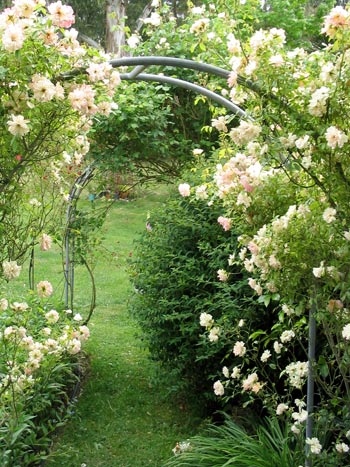
Character can be given to an entrance by simply having two ornamental pillars built there, with possibly an iron arch over them. If this is planted with creeping vines and is supported at the sides with groups of evergreens, it adds wonderful dignity and seeming value to the property.


{mosloadposition advert2}


While winding paths or drives are graceful, they should not ' be made meaninglessly, but are in order where the ground slopes a little or dips, or where irregularity exists. Certainly these can always be added or made in order to get the curved line. Even in small places, as cmplans show, the swinging line of beauty can be had. Straight paths may, however, be more convenient, and can still be tasteful and harmonious. They are undoubtedly neat.


No book can tell the reader exactly what may be the best arrangement for his garden or property. Every garden should have a character of its own, and generally does, unless in the case of the very smallest, where nearly all opportunity for variety is extinguished; yet it is remarkable what can be done on a quarter or an eighth of an acre. We have often seen plots of 30 ft. X 100 ft. Laid out with much variety and taste, and which were full of interest. In those towns and cities of our own country, and in the old countries where the inhabitants, almost to a man, appreciate the elegancies of gardening, the little places exhibit the utmost variety of character in their composition.


It is all too true that thousands of gardens and grounds all around our American homes are bare to desolation. The democratic idea and feeling against planting of hedges and the lining off of one's property makes for deadly uniformity. The arguments that unhedged or unfenced grounds would be contrary to the best artistic conception and treatment of a city or suburb as a whole, ought not to be allowed to sway the property owner from making the most and the best of his own place. There is a school of landscape gardeners and city planners who seem to set their face against this, encouraging the open community type of home grounds. The latter will never get us anywhere as a nation of garden lovers, and almost entirely precludes the practice of the finer gardening. We plead rather to see places nicely hedged or railed off, so that stray dogs and unceremonious persons may be kept at a proper distance, but most of all for the sake of the enjoyment and encouragement of that quiet privacy without which the true pleasures of gardennig cannot be attained.


Which is the best to have a big, bare lawn and a few trees, or an odd group of shrubs here and there, or the trimly hedged and fenced grounds, with flower borders, specimen trees and shrubs, beds and belts of Roses, arches of Roses and


Suburbanllot fenced, on 40x100 ft. A low hedge divided off the vegetable garden. Fruit trees and bushes were lined by the side of this, while pillar Roses, dwarf Roses, neat shrubs and beds of flowers were elsewhere well disposed. The vegetable plot was a model of good cropping, containing Tomatoes, Corn, Beans, Beets, Celery, Carrots, Spinach, herbs and salads. Raspberries lined the fences. This ran east and west other climbers, water basins, an arbor or Rose house where tea or icecream may be partaken in the sunny Summer days.


Haven't you seen many working men's houses just like this gaunt and bare, no neat hedges, no neat lawns, not even a Geranium or a Canna in sight ?


Some shady corner we can enjoy a siesta or a book in the open air?


The fact is we do not make half enough use of the grounds about our homes; they are left blank in most instances. We warmly urge the planting of light screen belts of trees and hedges around the property, which


need not be so dense as to prevent a neighbor or passer-by from enjoying glimpses of your garden. Regel's Privet, California broadleaved Privet, Golden Privet, Hemlock, Arborvitre, Austrian Pine, White Pine, Norway Spruce, Rambler Roses, Ivy, Ampelopsis, Plane trees, Berberis Thunbergii, are among the easily grown subjects that are useful in such screen belts, .and most of which can be increased on one's own place at little expense if the suggestions given in another part of this book are carried out.


The initial expense of planting the outer parts and main features of the grounds or garden need not be large. By the exercise of a little patience one can grow-on a good many things for future developments. Poplars should only be used sparingly. They grow fast, it is true, and for that reason are often employed, and in some places are elegant and pleasant enough, but generally they are "messy," losing their leaves early, and their roots often choke up drains. The almost constant rustling of their leaves and other aspects of the trees are disagreeable to many people.


Make provision for a good space of lawn, and treat the lawn well. Water in motion, as in fountains, is often desirable but is a secondary consideration, just as the number and amount of flower beds or borders is, as also the introduction of rock gardens, arbors and such like. The thing of prime importance is to have the main features properly planned at the outset the garage, the barn, the poultry run, the kitchen or vegetable garden, and the other parts of the place such as have been already spoken of, also the grading and terracing (if any), are among the first matters that require attention. Minor undulations or changes of the surface can be left for a future day. It is not, we repeat, necessary to have a cut and dried plan' from the beginning; far better let it grow with your knowledge of the place. What may be called the adventitious, luxurious or additional features will, practically speaking, take care of themselves. You will gradually come to find out the most appropriate spot for this or that. Do not be in a hurry; allow the place to grow up. It will suit your pocket better and furnish endless recreation and pleasure. It will keep your mind happy and active. You will be interested and learning all the while. This is true gardening, and the meaning and the reward of gardening and garden making.


Some pains should be taken to have clean, well-made paths. Take out 6 in. Or 8 in. Of soil and fill with clinkers, rough ashes or stones, finishing off with smaller stones, bound or rolled in with a little soil. For a strong, permanent road, concrete may be employed. If a cement surface is objected to, gravel can be strewn over before the cement sets, and be rolled in. Grass paths are comfortable and beautiful. Brick is also good. It is well also to have a tile or slate or wooden edging to the paths, as this makes for neatness and easy up-keep.


You will find that by walking around your district or other districts, your walks are as a book; at every turn you will gain some experiences or suggestions that may be modified or adopted with profit on your own grounds.


Lastly, there is no place so unpromising that it cannot, by dint of knowledge, skill, effort and some small financial expenditure, be made a beautiful or trimly garden.


A comfortable home on a public highway in the country. Is the hedge any detraction? On the contrary, does it not bespeak repose and quietude within? It takes little imagination to conjure up a pleasant garden here the fruit trees, the shrubs, the vegetables, the flowers, the children's swing, the rest house, the pretty lawn.


{mosloadposition advert3} that can be referred to, and from which valuable information can be got on the laying out of your home grounds.


The first considerations in the composition of a garden or the grounds about one's place are Privacy, Variety, Shelter, Balance.


The planning and arrangement of the features of a garden or of the grounds about the house should be as carefully considered as the choice and placing of the furniture in one's home, or the choosing of a suit of clothes, or a dress to wear. The same idea holds, namely, the planning of a suitable, agreeable, comfortable composition. The garden has been called the outdoor drawing-room.


The arrangement of the drives and the grading of the [[lawns]], the [[drainage]] when necessary, and the arrangement of the buildings and outhouses should all be preconceived and settled in an orderly, economical manner. As far as possible there should be no mistake about the main, permanent features. The minor features may be changed quite a great deal in the coming years and almost surely will, as new ideas and points of view assert themselves. This changing of the minor features is a part of the recreation of gardening. Thus one may considerably alter the contour of a shrubbery border, or may indeed eliminate it altogether. The same holds good of [[flower beds]] and [[borders]], which are easily altered, removed or added to; but with large trees or the heavier groups of [[shrubs]] the expense of removal and shifting prohibits this being done except out of dire necessity.


Where one has the choice of building one's house or choosing its location, the best aspect for it is where the front porch faces southeast; another good position is facing due south. In any case, as everybody likes abundant sunshine or ought to, see to it that the windows and living rooms face in the direction of abundant light. Those places that are hidden beneath a dense canopy or half a forest of trees may suit, and do suit, some folks, but actual layout of a backyard garden fenced, on lot 30x100 ft. Standard Apple, Plum and Pear trees were planted around the divisional fences. They did not unduly shade the hardy flowers. The smooth gravel path terminated in an arbor, over which [[Roses]], [[Ivy]] and [[Clematis]] grew. [[Rhododendrons]], evergreens, hardy Heaths, Viburnums, etc., with bulbs between, were used on the right hand border. There was a sun parlor at the back of the house. The garden lay due south they are terribly depressing to the great majority of us, besides being, one should imagine not conducive to health. Light, air, freedom, are good watchwords for the builder and planner.


Character can be given to an entrance by simply having two ornamental pillars built there, with possibly an iron arch over them. If this is planted with creeping vines and is supported at the sides with groups of evergreens, it adds wonderful dignity and seeming value to the property.


{mosloadposition advert2}


While winding paths or drives are graceful, they should not ' be made meaninglessly, but are in order where the ground slopes a little or dips, or where irregularity exists. Certainly these can always be added or made in order to get the curved line. Even in small places, as cmplans show, the swinging line of beauty can be had. Straight paths may, however, be more convenient, and can still be tasteful and harmonious. They are undoubtedly neat.


No book can tell the reader exactly what may be the best arrangement for his garden or property. Every garden should have a character of its own, and generally does, unless in the case of the very smallest, where nearly all opportunity for variety is extinguished; yet it is remarkable what can be done on a quarter or an eighth of an acre. We have often seen plots of 30 ft. X 100 ft. Laid out with much variety and taste, and which were full of interest. In those towns and cities of our own country, and in the old countries where the inhabitants, almost to a man, appreciate the elegancies of gardening, the little places exhibit the utmost variety of character in their composition.


It is all too true that thousands of gardens and grounds all around our American homes are bare to desolation. The democratic idea and feeling against planting of hedges and the lining off of one's property makes for deadly uniformity. The arguments that unhedged or unfenced grounds would be contrary to the best artistic conception and treatment of a city or suburb as a whole, ought not to be allowed to sway the property owner from making the most and the best of his own place. There is a school of landscape gardeners and city planners who seem to set their face against this, encouraging the open community type of home grounds. The latter will never get us anywhere as a nation of garden lovers, and almost entirely precludes the practice of the finer gardening. We plead rather to see places nicely hedged or railed off, so that stray dogs and unceremonious persons may be kept at a proper distance, but most of all for the sake of the enjoyment and encouragement of that quiet privacy without which the true pleasures of gardennig cannot be attained.


Which is the best to have a big, bare lawn and a few trees, or an odd group of shrubs here and there, or the trimly hedged and fenced grounds, with flower borders, specimen trees and shrubs, beds and belts of Roses, arches of Roses and


Suburbanllot fenced, on 40x100 ft. A low hedge divided off the vegetable garden. Fruit trees and bushes were lined by the side of this, while pillar Roses, dwarf Roses, neat shrubs and beds of flowers were elsewhere well disposed. The vegetable plot was a model of good cropping, containing Tomatoes, Corn, Beans, Beets, Celery, Carrots, Spinach, herbs and salads. Raspberries lined the fences. This ran east and west other climbers, water basins, an arbor or Rose house where tea or icecream may be partaken in the sunny Summer days.


Haven't you seen many working men's houses just like this gaunt and bare, no neat hedges, no neat lawns, not even a Geranium or a Canna in sight ?


Some shady corner we can enjoy a siesta or a book in the open air?


The fact is we do not make half enough use of the grounds about our homes; they are left blank in most instances. We warmly urge the planting of light screen belts of trees and hedges around the property, which


need not be so dense as to prevent a neighbor or passer-by from enjoying glimpses of your garden. Regel's Privet, California broadleaved Privet, Golden Privet, Hemlock, Arborvitre, Austrian Pine, White Pine, Norway Spruce, Rambler Roses, Ivy, Ampelopsis, Plane trees, Berberis Thunbergii, are among the easily grown subjects that are useful in such screen belts, .and most of which can be increased on one's own place at little expense if the suggestions given in another part of this book are carried out.


The initial expense of planting the outer parts and main features of the grounds or garden need not be large. By the exercise of a little patience one can grow-on a good many things for future developments. Poplars should only be used sparingly. They grow fast, it is true, and for that reason are often employed, and in some places are elegant and pleasant enough, but generally they are "messy," losing their leaves early, and their roots often choke up drains. The almost constant rustling of their leaves and other aspects of the trees are disagreeable to many people.


Make provision for a good space of lawn, and treat the lawn well. Water in motion, as in fountains, is often desirable but is a secondary consideration, just as the number and amount of flower beds or borders is, as also the introduction of rock gardens, arbors and such like. The thing of prime importance is to have the main features properly planned at the outset the garage, the barn, the poultry run, the kitchen or vegetable garden, and the other parts of the place such as have been already spoken of, also the grading and terracing (if any), are among the first matters that require attention. Minor undulations or changes of the surface can be left for a future day. It is not, we repeat, necessary to have a cut and dried plan' from the beginning; far better let it grow with your knowledge of the place. What may be called the adventitious, luxurious or additional features will, practically speaking, take care of themselves. You will gradually come to find out the most appropriate spot for this or that. Do not be in a hurry; allow the place to grow up. It will suit your pocket better and furnish endless recreation and pleasure. It will keep your mind happy and active. You will be interested and learning all the while. This is true gardening, and the meaning and the reward of gardening and garden making.


Some pains should be taken to have clean, well-made paths. Take out 6 in. Or 8 in. Of soil and fill with clinkers, rough ashes or stones, finishing off with smaller stones, bound or rolled in with a little soil. For a strong, permanent road, concrete may be employed. If a cement surface is objected to, gravel can be strewn over before the cement sets, and be rolled in. Grass paths are comfortable and beautiful. Brick is also good. It is well also to have a tile or slate or wooden edging to the paths, as this makes for neatness and easy up-keep.


You will find that by walking around your district or other districts, your walks are as a book; at every turn you will gain some experiences or suggestions that may be modified or adopted with profit on your own grounds.


Lastly, there is no place so unpromising that it cannot, by dint of knowledge, skill, effort and some small financial expenditure, be made a beautiful or trimly garden.


A comfortable home on a public highway in the country. Is the hedge any detraction? On the contrary, does it not bespeak repose and quietude within? It takes little imagination to conjure up a pleasant garden here the fruit trees, the shrubs, the vegetables, the flowers, the children's swing, the rest house, the pretty lawn.


{mosloadposition advert3}

Monday, June 28, 2010

Sicilian Spaghetti


Ingredients


  • 1 pound spaghetti

  • 4 tablespoons olive oil

  • 3 cloves garlic, crushed

  • 1 (2 ounce) can anchovy fillets, chopped

  • 1 cup fine bread crumbs

  • 1 cup chopped fresh parsley

  • ground black pepper to taste

  • 4 tablespoons freshly grated Parmesan cheese

    Directions


    1. Bring a large pot of lightly salted water to a boil. Add pasta and cook for 8 to 10 minutes or until al dente; drain.

    2. Meanwhile, in a medium skillet, heat olive oil over medium heat and add garlic and anchovies to cook for about 2 minutes; stir constantly.

    3. Stir in breadcrumbs and turn off heat. Add parsley and black ground pepper; mix together.

    4. Toss anchovy sauce with hot pasta and sprinkle with cheese; serve.